Espionage and surveillance
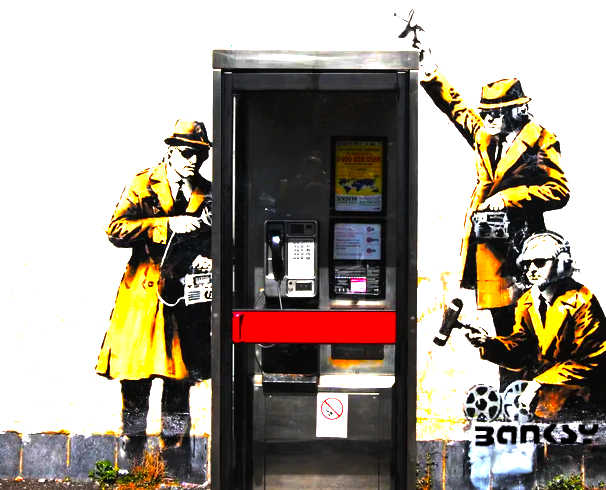
Clandestine activities undertaken to collect information are as old as human affairs. Whereas espionage tends to be targeted and purposeful, and surveillance opportunistic and broad, the terms overlap.
With regards to legality and morality;
- spying is morally wrong and psychologically suspect
- yet it is widely tolerated and sanctioned
- in a few cases it's illegal and severely (disproportionately) punished
- it reveals huge social schisms and conflicts of interest
Military
Every military worth its salt engages in systematic spying called "intelligence gathering". It's a multi-trillion dollar industry of satellites, cable taps, software, and human agents. Knowing the scientific, military and strategic capabilities of likely enemies is essential to preparedness. Sometimes called state espionage, conducted by intelligence organisations separate from armed forces,
Some problems accrue;
- distinctions between enemies and allies
- distinguishing civilians from military targets
- limiting spread of military technology
Allies may not remain allies, so all states spy on their friends. The U.S. National Security Agency (NSA) used Danish facilities to spy on European political leaders including German Chancellor Angela Merkel.
Despite international conventions the lines between civil, military and criminal affairs are increasingly blurred. More than one U.K MI6 chief has claimed the country now exists in a state of continual "hybrid and unconventional warfare" and "in a space between peace and war".
Governments
Democratically elected governments have a legitimate interest in census taking and basic civic legibility in order to function.
Tyrannical governments, for example the Communist government of the German Democratic Republic under Erich Honecker in the 1980's, or modern day China and India, collect massive amounts of information on religion, political beliefs, associations, movements, reading habits, social networks and health of their citizens.
This line is continuously pushed by governments ever hungrier for "data". The Internet allowed mass surveillance at unprecedented scale for almost no financial cost. However the political cost for democratic cultures is catastrophic.
Much of the capability comes from commercial interests who make and sell surveillance tools to governments, breaking down proper separation of civic state, commerce and military and creating new forms of Fascism. Thus technological temptation has weakened liberal democratic Western governments, undermining our ideological legitimacy.
Tyrannical states openly use surveillance for internal repression, identification of malcontents and dissidents for social and economic disadvantaging, harassment, censorship, smearing, deportation, or internment in forced labour camps.
Despicables (terrorists, pederasts and other elements of the four horsemen of the infopocalyspse) are the oft claimed justifications for oppressive, anti-democratic behaviours which only 80 years ago were considered worth fighting a World War over.
In business
Bruce Schneier astutely calls surveillance the [business model of the internet]. If laws were ever justly applied many of the largest companies today would disappear.
Companies can all claim that they 'only' engage in espionage and surveillance for "competitive advantage". This allows for almost anything, certainly a much broader remit than even the military or state can claim. These include;
- targeted advertising
- reputation management
- headhunting, recruitment
- industrial espionage
- markets for data
In these times almost everyone now understands that their phones, tablets, browsers, application software, and internet services are compromised and used to spy on them. We are all increasingly aware how the organisations supposedly responsible for our data security routinely lie to us.
The accepted 'excuse' is advertising, supported by a popular belief that 'consumers' have entered into a tacit and implied contract to give up personal data in exchange for free email and search services. It is a masterstroke of propaganda.
Most egregious are markets for personal data. Some miscreants assume the guise of "credit reference agencies" or "insurance auditors". Most are indistinguishable - by all but the most rarefied legal scholars - from common cyber crime activities. Ostensibly private intelligence agencies account for most of the opportunistic bulk surveillance, analysis and resale. A convenient symbiosis between public and private sectors allows both governments and tech companies to act outside the law by trading data and capabilities. Such corruption is illustrated by the Cambridge Analytica scandal.
Industrial espionage used to involve planting someone deep inside a company. It is now so rife, at such colossal scale, that we no longer even see it. People seem happy to send sensitive data and search queries to any random overseas company for processing (for example by "AI" tools). We happily use cloud or buy managed services giving remote access for updates, some giving privileged access to local devices. Such 'service providers' have unique visibility into any company's;
- suppliers and customers
- R&D road-maps
- trade secrets, patent applications
- risk exposure
- finances and administration
What sort of 'competitive free market' can possibly exist under such treacherous conditions?
The civilian cyber-arms trade is also unregulated and extremely worrying for business, peaceful civility and liberal democracy. Bossware, spouseware, childware, proctoring - everyone is being encouraged and goaded into spying on everyone else. To sell such products it is necessary to undermine morality, stoke fear and mutual mistrust, to commit serious harm to the fabric of society, to mental health and well-being. Such companies are best framed as industrial pollutants.
As technologists we see that such behaviour is a hazard to technology itself. It corrodes general trust in digital technology which might be extremely useful if used by better, legitimate government for building consensual digital society.
Conclusions
Hopefully this candid summary makes clear that there are no clean hands. All of this makes "The Internet" an extremely hostile network in which to operate, and renders many supposed long-trusted entities untrustworthy or openly treacherous.
We teach these 'threat capability' conclusions as being general to the Dolev-Yeo model.