Digital Parenting
!["[under construction]"](../images/family.jpg)
Parenting and teaching in the technological society
This is a short guide to "toxic tech" and what we can do about it by talking to our children.
In our work with schools, kids groups, mums and dads, we hear the same questions repeatedly. At root, it's always about one fundamental tension; between the supposed benefits and harms of technology.
"Should I give my kid this?" "How do I protect them from that?"
The one sentiment we identify in every situation is this;
Parents and teachers feel they are unable to make genuine, informed choices.
On one side, digital tech seems desirable, even a necessary part of modern life. Parents think they are doing the right thing by giving their children the earliest possible access to digital devices and online spaces. On the other hand all technologies come with some unavoidable harms and significant risks.
For parents: It is perfectly understandable that we want to give our children the greatest advantage academically, and with basic life skills. But where's the real science on this? Mostly we get it all wrong.
Since Rousseau's Emile and Doctor Spock (not that Star Trek guy) bookstores have been awash with half-baked self-help books on childcare for ambitious parents. So as parents, lots of what we think we know about developmental psychology, especially with respect to technology, is just wrong.
For teachers: It is very frustrating because we want to protect our pupils from harms. Cost cutting means few schools have a proper IT department any more. School heads and administrators are squeezed by budgets and schmoozed by US Big Tech salesmen trying to force software products into British schools which we [consider unsafe]. Companies like Google and Microsoft give privacy invading and propaganda spreading tech to schools for free to influence young people and get them hooked on it. Genuinely safe technology cannot compete unless governments step in and legislate.
Teachers in Britain do not receive a suitable independent and objective training in cybersecurity and digital rights of young people. It would be a big help if teachers had access to genuine independent advice.
Over-cooking tech
In Britain we see anxious kindergarten teachers trying to hot-house four year-olds with maths and reading. By seven they're being pressured into "thinking about their future" and whether SATS tests should be applied. Meanwhile, children in Finland don't even start school until they're eight! And the Fins have much better educational outcomes. We allow our children to become part of a giant experiment in educational technology and the results are frightening.
We would all like to help our children make good choices. We aspire to prepare our children for the challenges of life; the economy, changing climate, and political upheavals. They ask; Should I marry? What kind of job is good? Can I trust the government? Is college a good idea? Will I ever own my own home? But unlike these wider themes of life, about which the wise parent will say ["Que Sera, Sera"] and hope their children are blessed with good fortune and peace, there's something very rotten about tech.
Tech is emotionally twisted
Challenges lie not just in technical matters. Computer systems can be neutral in their values, unless interfered with and made harmful by software vendors who put profit above child safety. That is why we recommend Free Open Source Software for schools.
Emotional intelligence is needed to understand the problem.
From Silicon Valley (California) in the United States, much of our digital technology has inherited very negative emotional qualities. It is;
- Impatient
- Anxious
- Arrogant
- Rigid
- Neurotic
- Paranoid
- Dissatisfied
But this is just a socially constructed situation. Tech need not be like this. It's like this because the ideas of a small group of ultra-capitalists have taken the ball and run off with it.
Presently, digital technology is too restless. It is not simply fast-moving because of rapid advances and Moore's Law, it is always actively trying to reconfigure itself, to move-on and discard the past. By the time any experts and governments can research and formulate advice, it's all changed.
It is intrinsically dismissive of tradition and hard won wisdom. It always "knows better" and so is reckless.
No reasonable person would be so arrogant to claim they know the future, the totally right way to do things, or how you must think about everything. But when it comes to tech there's no such humility or thoughtfulness. We've regressed to a way of thinking we abandoned in the 17th century, before [The Enlightenment].
Once upon a time, people rejected religious dogma and superstition. We stopped punishing others for their different ideas. We called that "progress". But just as terrorists and freedom fighters become the new chancellors, the "progressives" became the entrenched, dogmatic ruling class. The circle has completed.
In the 21st Century, our technology has returned to a rigid and superstitious kind of thinking. The choices we make around technology are governed by fear and confusion, not clarity and joy.
We are bombarded with breathless, oh-so-certain ideas on how you should think about technology - what you must "embrace" or be "left behind". Our ideas about tech have become unreflective and stuck.
Tech became toxic because we're not properly critical of it. It became something of a new religious cult led by quite bizarre and scary people. A berzerk charge is led not by careful scientists, but by charismatic demagogues, ranting fundamentalists and intransigent government acolytes. Reason has left the building.
The importance of choice of technology
How we each use tech is a choice. Because that choice has such a strong effect on growing minds, choice is a basic right, it's a social, political, and moral act.
If the school forced every child to eat at the same cafeteria and all they had on the menu was chips, would you be happy?
Technically there's nothing 'wrong' with chips - the school says. Most of the kids like chips. It's food they eat "in the real world". Why are you so sniffy? Are you an 'elitist' or something?

Those are the kind of silly arguments we sometimes hear when we raise the issue of choice and technology. Something about tech makes people a little too docile in accepting imposed decisions. Worse is when the justification for those decisions is simply economic, or hiding other deficiencies in the administration of the education system.
It's time for that to stop. Because unless you and your child can make meaningful choices about tech use, they'll suffer a lot of limitation in their creative range and opportunity. Our tech choices set the tone of our civil and moral life, they're part of our identity.
For example; Without the right not to drive a car our environment is doomed. Even though a lot of modern life does depend on the ability to drive an automobile would you be happy if the government demanded everyone drive a car and withheld basic services and rights from you because you choose to walk?
Likewise, unless we defend our right not to use toxic technologies we are all on a dangerous path. Because there is so much pressure on us to [ surrender in the face of technology], good technological health and security is becoming an art of resistance and self-determination. Nobody should mistake that for a rejection of technology. It is simply the demand that we remain in control of it.
An intelligent, free person has the right to choose to manage their life without anyone assuming they carry around a smrtphone, or be signed up to four or five private social media platforms just to get along. Many young people are finding this is how they want to define their lifestyle and not follow the previous generation into frenetic technological over-connectedness.

Retake your choice
There are many diverse ways to understand and use digital technology. If we are to improve our mental, physical and social health we must offer our children alternatives.
Unfortunately for the past few decades purely industrial forces have taken-over culture and education. They try to sell us only one impoverished vision of technological life. TikTok, Instagram, Microsoft Office, Google Maps, Amazon Prime, Apple Pay… these monopoly brands have become synonymous with our ordinary, everyday activities.
Worse than this, so-called "AI" is already becoming an unashamed tool of political [propaganda] and [advertising].
That is extremely unhealthy and should seriously worry every parent and teacher.
Under these conditions, instead of technology being a neutral utility it has become a political battle-ground and socially toxic.
Rethinking tech
People may better understand technology as a set of principles and social [Affordances], not as a list of brand names for commercial apps.
For example; Think of the idea of writing a letter using a basic text editor instead of using a Big Tech "Office" product that tries to suggest "AI" assistance. In Linux alone there are literally hundreds of different text editors! Some of the world's best writers still prefer the ancient but amazing [Wordstar]. One of the staff at Boudica wrote a 650 page academic textbook for MIT using an editor called [Kate].
Simpler FOSS software is much easier to teach. We remember more when we use it.
It is more stable, so the interface doesn't change with each version making it necessary to re-learn.
It's more secure, because it's simpler, and open to scrutiny.
It teaches principles not products, meaning broad transferrable skills that apply to other software apps.
That rotten old myth that "kids need to learn Microsoft because that's what they use in the workplace" is now dishonest and pretty much dead. If using Microsoft Office 365 is the height of ambition for your kids, please, please for their sake aim higher!
Understanding harms
For kids, there are four broad areas in which tech affects our immediate interpersonal life;
- the parental bond
- social environment
- education and information
- entertainment
Let's look at some of the harms and how we can do better for young people.
Invisibility of digital harms
Parents don't see much when kids are harmed by technology. No bruises or cuts. So we think they are okay. But like bad diet, smoking, and exposure to pesticides or asbestos, harms are invisible until deadly symptoms appear.
That means we must prevent exposure to harmful technology before it does damage or gets out of control.
Harms to the person
Some things harm our kids directly, making them weak, less focused and less intelligent. Other effects aren't direct, but they hurt our kids relationships, education, social values and opportunities.
Harms to the body
Fortunately young bodies bounce back to health if damaging behaviour stops, so it's worth intervening early.
There are some physical symptoms to watch for.
- Tired and red eyes from staying up late using devices.
- Sore necks, dropped posture
- Circulatory, stomach and nervous problems
Over-use of small hand-held devices eventually leads to vision problems and damage to the muscles, joints and skeleton in the worst cases.
Damage to [eyes] happens because phones get held very close to our faces. Prolonged exposure to high-energy blue photons leads to retinal damage. Eye strain of the muscles causes fatigue, dryness, blurred vision. Sleep disruption happens if devices are used too close to bedtime because phones mess with melatonin production.
Holding the same posture for hours on end is not good for you. In fact it's a torture technique! So called [Smartphone Syndrome] also applies to tablets, and even seated desktop use. Adults in the workplace are subject to health and safety regulations for computer use. Shouldn't your children enjoy similar protections?
Regular physical breaks - at least a half hourly stretch - are needed to stop blood stagnating in the legs and lower body. In the worst cases, some young gamers have died from thrombosis (clots caused by immobility).
Erratic eating is common with addictive, absorbing activities. With continued use this can lead to eating disorders, a loss of interest in food and exercise.
Harms to the mind
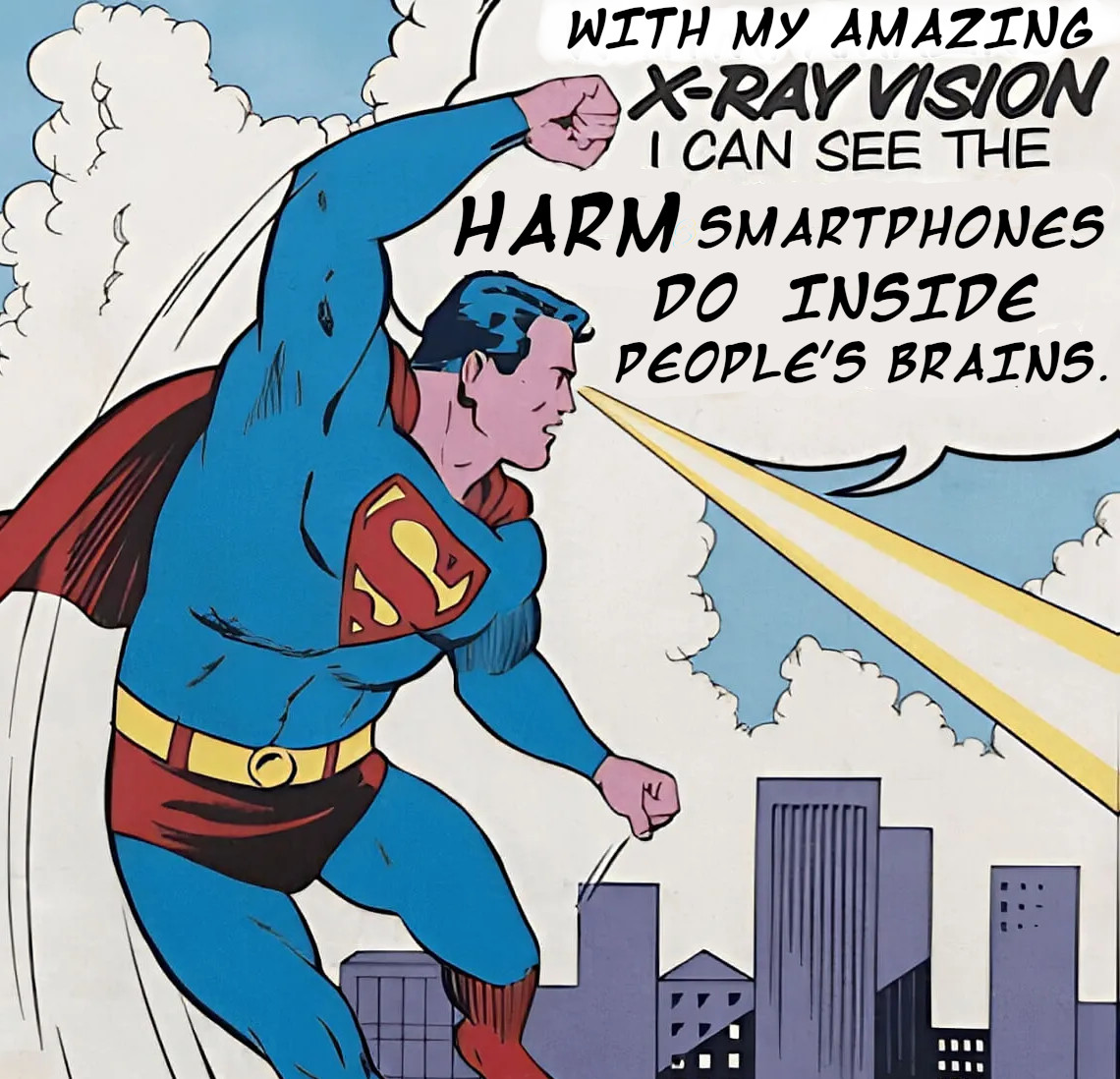
Most worrying is what smartphones and addictive online activities do to children's mental well-being. This includes;
- Harms to attention
- Harms to attachment
- Harms to sociability
- Harms to inner life
- reflection
- executive function
- self care
- care for others
- loss of ambition
- loss of direction
These effects will persist for generations. Their cumulative and long range effects may even create an [Idocracy] (catastrophic "intellectual collapse"), undermining our ability to maintain peaceful, prosperous societies. For example we now face a colossal shortage of maths and English teachers.
Dependency
Maybe the greatest overall threats is dependency. Mental ill-effects on the population may seem bad now, while the technology is all working. But what happens if it suddenly switches off? Most people won't magically "get better" and cope. There will be widespread panic and systemic damage to the function of the whole country. It's something we think about in defence, with regard to cyber-war.
The problem of having all your functions in one device (voice communication, texting/email, address book, banking, torch, maps, books, medical access….) is that when it breaks, everything breaks. In security we call that a single point of failure.
Obviously a sensible civic defence strategy is to reduce dependency. Teaching kids how to use alternative tech, do traditional things like write with a pen, take a photo with a camera, cook a meal, read an analogue clock… will at some point become the difference between survival and perishing.
Attention
[Surveillance capitalism] and the [attention economy] are extremely corrosive to civilised society and general happiness. Stealing of attention is what street magicians, pickpockets, and confidence tricksters all excel at. Messing with someone else's attention for profit and gains demonstrates a criminal mindset.
It is devastating to education. It's no wonder our children cannot focus and learn well when exposed to these influences.
Attachment
A very important part of healthy psychology is our [attachment]. We each develop different attachment "styles" the most desirable of which is secure attachment.
When attachment is disturbed we aren't able to form good relationships or make any sense of life. To have damaged attachment is frightening, lonely and depressing.
"AI" is all about "attachment hacking". "AI" is fake people. The fancy word is anthropomorphisation… pretending to be another human. A machine cannot think or feel. But when we are tricked into believing it can think and feel that really messes with people's attachment patterns.
Banning "AI", certainly in schools is a no-brainer. 1 British government has - rather foolishly in our opinion - invested a lot in "AI" without considering the wider social consequences and against the clear advice of many of the world's expert computer scientists. That makes a reversal very controversial,
The cover that these are "useful life skills" for a "new economy" is nonsense. Most applications of these amusing word salad generators are jobs nobody wants anyway. It would be much simpler to eliminate that [makework]. Teaching "AI" is sending our children into an intellectual cul-de-sac.
The real skills for the future are humane, in-person, interpersonal, and social.
Social function
Damage to social function has directly tracked mobile technology and is deep and obvious to anyone who has watched the last three generations grow up. With the exception of a few explosive young voices like [Greta Thunburg] the general ability to [speak with confidence] has got worse year on year. It's just one of a terrifying array of markers that show social intelligence has plummeted due to digital overuse. Other factors include lowered ability to;
- read a room
- approach a stranger
- start a conversation
- end a conversation
- manage a queue politely
- exercise patience, manage boredom
- argue a point
Many young people say they are frightened simply to be in public places, holding-in a lot of high-anxiety behind a blank-face. They seek to avoid eye-contact and situations that would require conversing. That is not normal or healthy. 2
Executive function
Multiple [studies] have now confirmed that since 2012, when smartphones really went mainstream, basic executive function in young people fell off a cliff edge. That includes serious damage to ability to;
- plan the day
- [tell the time]
- [read and write] 3
- Do mental arithmetic
- walk a city block
Inner life
Politicians worry about "blocking porn" but that is just one thing to worry about. Relentless exposure to negative news, anger, trolling and mocking by supposedly "adult" political figures, to fake news, bizarre stories, insane "AI" images, racism, misogyny, genocide… Now add the pressure to look good, say the right things, think the right things…
It drives young people crazy. It shreds inner life. Coherent thought and ability to process reality is disrupted.
No wonder the "smartphone generation" have that blank, traumatised stare.
Where do I recognise it from? Combat veterans.
As if adolescence was not already a hormonal roller-coaster of personal change, insecurity and self-discovery, who needs the burdens of the world forced upon them because oligarchs want to sell gadgets and the grown-ups are too afraid to stop them?
We need to help young people create a space for healthy inner life that includes:
- a sense of future
- hopes and dreams
- faith in authority
- laws, consistency, expectation of peace
- sense of belonging, community
- sense of self-worth and purpose
Civic cybersecurity sets requirements for social and psychological security as well as technical defences against computer intrusion and snooping. Without it, our devices are our enemies.
Moral injury
Moral injury happens when you're forced to do or agree to something that offends you and goes against your ethical judgement. It produces deep feelings of guilt, shame, and disorientation.
What do you do when your teacher tells you that you must use Microsoft, but it's in the news that Microsoft are [helping] to bomb children? Not to pick on Microsoft for any reason, because all Big Tech companies are up to their necks in unethical behaviours.
And it doesn't help that they "apologise" and say they'll fix it, because these sorts of people just go and do the same awful things in a different way and hope they won't get caught next time. Google [keeps firing] its head of ethics, because that job is clearly impossible.
It is wrong to make anyone use products connected to companies that they have a profound moral aversion to. Of all institutions, schools, universities and youth organisations should never do this.
Unintended consequences
Perhaps a most pernicious problem comes from our belief in things that claim to do good but actually do harm. We are sold technology, and so far a great deal of it is a damp disappointment;
- social media made people less sociable
- educational technology made people learn less
- smartphones made people dumb
- "AI" is making us all [less intelligent]
There are many explanations why this sort of thing happens and plenty wisdom about perverse incentives, side effects and errors in how we measure outcomes. We even have a word for this in medicine. Iatrogenic means things that kind of ironically do the opposite of what we intend.
A key word is "atrophy". If someone breaks a leg we might give them crutches. Initially that helps healing. Some mobility improves circulation and some pressure knits the bone. But if a patient stays on crutches too long their muscles grow weak. It is time for them to literally "stand on their own two feet".
Likewise we've discovered that using GPS destroys our ability to navigate spaces. Using search erodes our internal map of meaning. "AI" it seems, stops us from thinking at all. This is not "evolution" or "progress". Its a disaster. Tech is supposed to be an intelligence amplifier ("IA"), which is kind of the opposite of "AI". We're doing tech wrong!
Drivers of toxic tech
Several factors drive young people toward toxic technology:
Disappearance of real life community
In the 1970's and 80s, governments tried to build community leadership. Youth and sports clubs were everywhere. Child sexual abuse scandals left such a deep scar that we shut-down trusting adults, and adults who would volunteer their time now suffer ingratitude, over-bearing scrutiny and suspicion. Today, outside a few traditional church and scouts groups there's not much community leadership. Yet children seek all kinds of appropriate mentoring and healthy relations with adults beyond the family and school. It takes a village to raise a child. In many ways "online" (locked away in a bedroom) is a much [more dangerous] environment that "real world".
Fear of "outside"
Fear of going outside makes parents keep kids indoors almost under house-arrest. Fear of dangerous drivers, knife crime, drug pushers and paedophiles. Going to the park to play is no longer an option - and the last time I looked my local council had stopped funding play areas and let them fall into ruin. This fear drives parents to give overly featured phones to children as tracking devices.
Government Ideology
Regardless of changing political party leadership, pressure to adopt technology is overwhelming. It's become a fetish. Governments want to create a "digitised society" too quickly, whether that's a good thing or not, and so push technology regardless of whether it's appropriate or not. Some children are even denied vital medication because the only way to administer it is via a smartphone app!! At a time when we're realising the massive damage smartphones do to young minds it's extremely irresponsible of governments to pursue these ideological social programmes.
It's like Philip Morris did a deal with government to install cigarette machines in schools.
It seems there are no cautious or thoughtful representatives within the current party system. Until 2025 going against the hegemony of US Big Tech was suicide for UK political candidates. With any luck that's all about to change in the UK as it is already is in Europe.
Privacy, young people and trust
We interviewed about twenty children aged between 13 and 17 at a local shopping centre and skate-park. We asked the questions:
- "Is it okay for the government to spy on people's phones?"
Unanimous Answer: No
- "What about children, for their own protection?"
Unanimous Answer: "That's even worse! Absolutely, no!!"
Not only do children deserve privacy, they have a greater right and claim to it. They are more vulnerable and more sensitive to intrusion. They have less motives to act criminally. This leads to a tension. Adults should rightly want to know what children are doing to keep them safe. However young people need a private space to play games, explore relationships, explore knowledge, have fantasies, discover their own bodies, desires and interests.
Teenagers go through a process of individuation and separation. Helicopter parenting, non-consensual tracking and intrusion are very damaging and destroy trust. On the other hand, an overly permissive approach invites trouble. You must find the balance.
So Digital Parenting is about building trust and cooperation.
- Regular check-ins to talk about "Online"
- A shared interest in digital self-defence
- Respecting each other's cares
- Keeping promises and boundaries, on both sides
- Shared critical thinking and scepticism around tech
Understanding behaviours
Much education happens through peer interaction. As Sugata Mitra and Ken Robinson [have shown], self organising education where children guide the younger or less able students is [absolutely natural] and often superior to top down instruction planned by adults. While it offends our sense of control that this happens, it's a reality, and one we can take advantage of.
With any luck governments will ban smartphones and Big Tech social media for under 16s. However, the problem will only move to new modes and new platforms unless we address deeper issues. Kids will still want to use technology to share and socialise, because we made the real world too scary.
Because of the society we've created (see Drivers above), trying to stop digital connectivity for young people would be cruel, hypocritical and a failure.
Helping our kids build their safe digital world
So we should help them. We do that by building real social technology. If left in the hands of corporations like TiKToK and Meta, social technology will always be exploitative.
If we want to move them away from toxic tech, we need to build a new ecosystem of non-toxic digital technology. It takes surprisingly few resources to do that. But it will take enormous political courage. Big Tech will do everything in it's power to stop that.
What would alternative technology look like?
- Community driven
- Community funded
- Community administration
- Local first
- Empowering to young people
One initiative we tried at university course was "Build Your Own Facebook in 400 lines of Python Code". Once young people see how easy it is build their own technology the effects are exhilarating!!
It's certainly not beyond the skills of a few intelligent parents and school teachers to deploy a server with Free Open Source solutions, federated social media and community cloud to serve thousands of local users.
Such systems would be under local control of parents, or better, with supervision under the children themselves who have a learning path to responsible system administration as a life-skill.
If a village of illiterate Indian children can pull it off, surely our kids can.
Digital dialogue and negotiation
The best outcomes we can expect will come as a result of talking together, negotiating values and boundaries.
Rememeber this is an ongoing process. It's not an attempt to draw up a a perfect contract to be chiselled in stone and enforced with an iron hand. The aim is to track your growing child, changing technology, changing laws and norms, and your changing parenting style.
Parents may wonder whether there's any point trying, or worry that they may just scare their children. Some leap of faith is needed to give kids the benefit of the doubt and offer them the most generous assumptions.
It may start off awkward and suboptimal. You and your kids will get better at it.

Age and context
Children as young as 6 can understand the complexities of "bad people" and "hackers" as well as draw distinctions between the digital world and the physical world. Explaining to children at a young age that there are also bad people, like robbers on the internet, lays the foundation to continue to add more complexity as they grow.
Be aware of how media normalises and reinforces behaviours you'd like to challenge… and challenge it! Films and TV series showing teens on smartphones may soon look as weird as programmes from the 1970s full of arse-slapping misogyny, casual racism and where everyone is smoking fags and constantly swigging alcohol.
Negotiating ownership and power relations
It's important to remember your leverage and responsibility. In most cases you'll be paying for the online connection even if the kids feel they "own" the device. If your child is under 18 they cannot manage a contract, console, subscription, tablet or laptop account. In technical terms they have "no capacity". Legally, whatever happens on those accounts is the responsibilities of the contract owners.
The relationship should change and follow a gradual relaxing of oversight. Make children aware of your responsibilities when providing accounts for devices and how they are inherited as they age. When it comes to separation and gracefully handing over responsibilities tech can be a great way to do this. Though some assets can be transferred at 16, ideally you want all responsibilities to be transferred to your new adult at age 18.
That doesn't always mean your oversight need stop. Further digital assistance can be offered, if they ask. A positive early relationship around tech can turn into lifelong mutual support and intelligence sharing.
Regular checkins
Most of the good parenting guides emphasise some sort of regular check-in or review.
Create an agreement to have checkins about every fortnight or every month. The exact ritual and ministrations will depend on age. Basically in these, you both sit down together and go through:
- history
- installed apps
- contacts
- feelings about tech use
Assure them any interaction with their digital activities is only for safeguarding and not to invade their privacy. Ensure that you stick to that boundary. Breach of trust would be very harmful.
When they gain access to a new app, device, game or external communication, research and assess the risk it may bring into your child's digital life. Discuss the dangers and any rules before granting access to new digital tools and activities, tailoring the advice for age.
Limit which apps they have access to and let them know when they are considered old enough to access them and why. You can use our advised age rating for assistance - but those branded Big Tech platforms will change or disappear in time.
Surveillance, visibility and consent
Clearly explain to young children, pre-teens and teenagers that all online activity can be accessed, tracked, recovered and leads right back to the internet provider and home. Nothing online really remains secret unless we make a conscious effor to make it so, everything we post, publish and interact with creates a digital footprint which people may have to account for.
Explain that privacy and secrecy are different, but both natural. Grown ups do use encryption for a thousand very important reasons like keeping business secrets, protecting online banking, confidential communication.
Start from the basis that privacy is a [natural human right] in a bid to obtain consensual legibility - in other words we want to let our children invite us in to their digital world as benevolent guardians.
At the same time, stamp down hard on any messages that make them feel ashamed about a natural desire for privacy. People who don't want others to have secrets reveal the seeds of their own abusive behaviour. Don't let children fall victim to silly and dangerous ideas like "If you have nothing to fear you've nothing to hide". Every normal person has ligitimate secrets.
Explain that your desire to be allowed to see what they're doing is not at odds with their right to privacy, and that young people have a right to privacy and dignity online, as does everyone…. but because they are still children - and you are their responsible carer - the rules are a little different… for now.
Talking about harms
Explain the many dangers and concerns adults have about what children:
- may find by accident
- be tempted by
- be manipulated into
- be unwittingly exposed to
In an age appropriate way explain some of the types of online predators:
- People trying to get money from them
- Companies trying to get them addicted to products
- People who want to have sex or abuse them for fun
- Advertisers and data vampires who want to steal their personal info
- Bullies and trolls who want to upset them
Explain how data about people, espcially young people, is collected, brought and sold daily. Tell them how that is morally wrong, but we are still struggling as a society to put a stop to it. Don't normalise spying or make it seem acceptable.
We are simply helping them reduce, and secure that footprint and therefore themselves digitally.
Sharing and online persona
Talk about oversharing. Though it is nice to be trusting and open, it's important to be guarded too. Focus particularly on use of cameras and sharing of photos. Distinguish selfies and snaps of people from those of objects and places. Talk about how digital photos reveal where you were and when.
Talk about device tracking. Explain how the network knows where a device is, and how that can be beneficial. Tell them how much better that makes parents feel if we can know where our children are, but - at an age appropriate time - how that can be dangerous and that it is also their right to refuse and turn it off.
At a slightly older age, talk about anonymity (when nobody knows who you are) and pseudonymity (when you use a consistent nickname or handle). Explore why this is okay and sometimes a vital tool to keep safe. Explore ideas around how much you really know someone's identity, and how to reserve less trust for anonymous or pseudonymous contacts. Discuss how pseudonymity is important for keeping a distance (controlling proximity), developing and exploring parts of your own personality, and when it's time to burn and move on from old identities and circles of association you've outgrown.
Discourage young people from building a permenant online digital record, filled with over-sharing, comments and photos that will come back to haunt them. Steer them away from "real-name" policy platforms that aim to bind too tightly to their real identities and profile them (such as Facebook etc).
Demonstrating good faith
Ensure everything you do with their device is in the open, always check devices, settings and apps with your child present. Explain what you are doing and why, which harms it reduces and discuss any content you find unacceptable or worrying. I find it more successful to do this with all the family present as they children will learn from each other's mistakes and successes.
Clearly outline website, apps, videos, groups and platforms you find unacceptable and apply the restrictions to the accounts. Prepare for your child to find workarounds and apply known consequences such as device or account removal for set-periods.
Explain to teenagers and pre-teens missing web history, application or chat data will result in device removal for a set period, lay the foundation of trust working both ways.
Limiting screen-time for children over 11 is difficult as much of their learning and socialisation post-11 involves the digital world, it can be counter-productive to enforce set periods, instead set the devices to switch off at least 2 hours before bedtimes to shape good sleep and help prevent "doom scrolling".
Encourage "Hope scrolling" 4 instead and ask them to report their most optimistic, interesting or funny finds to you to "cheer you up"!
Auditing
Several guides to digital parenting advise making regular checks on your childs device.
The question of sharing passwords is interesting and will vary depending on family dynamics. Some families share all their passwords because they have more common devices and services - for example everyone knows the router password, or the Netflix login if you use that. However respecting each other's boundaries is also a sign of trust.
Some guides suggest "random checks". However, that can create an atmosphere of suspicion and mistrust. You don't want to become the "phone police". Instead negotiate audits as part of your regular digital check-in routine.
What to check for and how to check?
Review the device operating-system level settings for privacy and security as well as the device OS vendor (Google, Apple, Microsoft) making sure it is not sharing data, location or images with anyone. For most recent devices and OS versions turn off any "AI" settings! Especially for Microsoft, disable or remove any "assistance" features because these all leak your child's private data over the network and to advertisers.
For feature phones and smartphones, look at the installed apps on the main screen first, if you don’t recognise the apps run a check on them using a search engine with: "is (app name) safe for children?"
Dumb phones, if they allow app installation at all, only offer a tiny selection from a well curated "extras" store. That's one reason a dumb phone is preferable.
If you find suspicious apps which have not been mutually approved, discuss each one. If they don't seem right uninstall them and talk to your child about why they wanted that? If on reflection they seem suitable reinstall and review any settings together.
Any sorts of "AI" chat apps or "digital friends" should sound loud alarm bells. Our advice is that these are toxic and can lead to serious addiction and behavioural problems.
Any gambling apps, dating apps, online betting and so on are entirely inappropriate for under 18s.
Look carefully for anything that seems to ask for payment card details or has it's own account to sign-in.
Reviewing settings
Sometimes it is not a whole app that's problematic in itself, but how it's configured. A finer grained approach is to focus on settings.
Rather than ban an app entirely it may be better to allow it, but configured safely. However, be aware a sneaky child may change settings and then change them back, so tailor to your trust levels.
When reviewing app settings, head to "privacy and security" settings and switch all to the most private modes. Remove any location tracking. If location tracking cannot be turned off, that app is unsuitable for a child and should be removed.
Beware of treacherous apps that modify settings after updates. Many sneaky apps assume you won't look at the settings again after first configuration. Then they push an update (often mischievously labelled a "security" update") that turns tracking and access to private files back on. If you ever encounter such behaviour immediately remove that app permenantly and report it to the Information Commissioners Office as data harvesting malware.
Chat apps
Review group chat shared on popular applications. If we use WhatsApp as an example, head to any group chats and click the 3 dots for settings, click on Media, links and docs. Now review the content being shared between the group to assess any risky behaviour, such as sharing personal images or dangerous links.
Have a quick review of text messages looking for any unsaved contacts who have been communicating with your child. Scammers are very good at what they do, and children often engage with them which can lead to many harms for the family. Without good reason to, do not read personal messages between your child and their known contacts to keep the trust in place. It's good parenting to know who your child's best friends and trusted circle are.
Web activity
Review your child's browser history. There may be more than one installed browser. Make sure you can see the entire history for each day and times they would be on the device. If there is data missing, they are likely hiding some website use from you and have broken trust.
With Internet history audits you should only be looking for anything highly dangerous. No need to discuss every interest or read too much into your kids motives. It's easy to jump to false conclusions.
Much of what you see will indicate how advertisers are spying on your child and how manipulation algorithms have profiled them. This can be very disturbing, but again, it's very often way off the mark so don't jump to conclusions. Pay attention to anything that relates to:
- eating disorders
- pushing drugs and 'therapies'
- beauty treatments and body modification
- knives, guns, weapons
- cryptocurrency and financial schemes
- hacking friends accounts
- porn sites, rape, animal abuse
- gangs and secret societies
- extreme politics, misogyny, race hate
Any dangerous internet activity must be dealt with immediately with a clear discussion of the dangers. Privilege suspensions or device removal may be needed while you talk things over.
Dangerous Popular Apps
This list is a rather parochial snapshot (Jan 2026). Don't expect it to remain current:
- Telegram: Easy access to illegal substances and black markets, it
is also used for crime and extremism so comes with a grooming
threat. It is managed and run by a foreign government.
- Advised Age Rating: 18
- Aggregated harm rating: 6
- Snapchat: Sexual harms, easy access to illegal substances, can
location track which is accessible to contacts if not managed
correctly.
- Advised Age Rating: 18
- Aggregated harm rating: 7
- TikTok: Facial recognition data is harvested by a foreign
government as well as usage data. Has also been investigated for
highlighting underage content to adult users.
- Advised Age Rating: 16
- Aggregated harm rating: 8
- Meta: Tracks activity, microphone, videos, photos and user
interactions which is categorised and used for targeted advertising
to the highest bidder. They have been investigated multiple times
for political interference and spreading mis/disinformation which is
targeted using collected data.
- Advised Age Rating: 13
- Aggregated harm rating: 6
- Access to any unfiltered and unmoderated live chat rooms.
- Advised Age Rating: 13
- Aggregated harm rating: 3
- WhatsApp and other ChatApps: Can lead to sextortion and
cyberbullying.
- Advised Age Rating: 11
- Aggregated harm rating: 3
- Google: Tracks, saves and can transmit live location data of
smartphones, if not managed correctly.
- Advised Age Rating: 11
- Aggregated harm rating: 4
- Xbox, Playstation Live and others: Allow moderated and text based
chats only.
- Advised Age Rating: 8
- Aggregated harm rating: 3
Boundaries
!["[under construction]"](../images/construction.jpg)
[ Kate's part on trust and boundaries ]
- attachment patterns
- range
- association
- time management
- peer pressure
- social pressure (fashion and advertising, commerce)
Blocks to changing
Changing behaviour whether for yourself or other family members is really difficult. Starting a new diet. Quitting a bad habit. Learning a new skill. It all takes effort. It can cause friction and strife. But it's worth it. Life need not stand still.
Technology is a living, changing thing. It has no fixed goals even if governments make policy mistakes or misjudge the lay of history.
Here's some positive benefits to consider;
Gratitude
Your kids will really thank you one day. Maybe not next year. Maybe not for 10 or 20 years. But one day you'll hear something like;
"Mom and Dad, I know you were strict and I called you an idiot, but thanks for not letting me…. thanks for telling me…. I'm glad I didn't turn out like Billy Spanner… "
Less pain down the line
If you can't feel unselfish love then at least look at it from a selfish point of view; Less time dealing with police, social workers and hospital ED doctors. Less money spent on rehab, therapy, extra lessons to get into college.
For your country
Many digital harms are invasive species from overseas. Facebook, TikTok, Insta, and the companies making chatbots and digital heroin are not exactly friendly toward Britain now, even if we once thought they were. They know it harms our youth and it's part of their plan. Some of them even gloat over it.
However, we often fall back on excuses to avoid the inconvenience of action or difficult thoughts;
Non interference
"They're grown up now. It's not my place to interfere."
When did a loving relationship, taking interest, talking about things together… become "inteference"?
Fear of missing out (FOMO)
"I don't want my kid to be 'left out' "
Convincing you that you'll be "left behind" is the slickest and most devious trick the advertising industry came up with.
You will not be disadvantaged. If anything, moderating technology and making positive choices about it will hugely advantage you and your kids. They will learn;
- self discipline, focus
- how to cope with boredom, time management
- how to talk to other people, eye contact, conversation skills
- become better at mental arithmetic and reading
Ask this question; "Left behind from where?"
Where do you suppose a society that's totally immersed in and totally dependent on technology is going? Nowhere good!
Appeal to authority
"If it was that harmful the government would do something about it!"
We are doing something about it. Toxic tech is now recognised as a very serious problem. It takes time. Children were allowed to smoke for decades in the post-war period (1950-1970). Governments are reluctant to be reactionary or risk damaging trade and economies until things are very clear. Make no mistake - they are very clear now and the scientific evidence is in. It's damning, and action is finally afoot.
Britain is a liberal democracy and we don't like to interfere in family life. That means we each have some responsibility to contribute to good parenting;
- Talk to other mums and dads.
- if still alive ask your own parents. Generational wisdom should be valued.
- Get support of teachers and community leaders.
Parenting is always contentious. You may want to be more or less permissive and no government really wants to be a 'nanny state' - for one thing it's just too expensive and divisive.
It is no good hoping someone else will just "sort things out".
Suspicion of authority
"The government don't know what they're doing!"
This is true sometimes. There is no single truth and way. Many parts of government disagree with each other. Authoritarians in police and intelligence want to increase surveillance even when we know spying is a harm that damages trust and hurts democracy. Government's aren't great at IT and technical things. Public positions don't pay as well as working for Google or Amazon, so we lack the best people.
Lack of confidence
"I'm not an expert"
You might not be an expert about computers and communications technology, but you are an expert on your own children. You can see what toxic technology is doing to them. Trust those instincts.
Naturally there's lots of lies and disinformation from tech companies themselves. They control the channels where you get your news and opinion. They try to paint cautious social progressives, conservatives, and just people who "think about stuff too much" as crazy wacko's and "conspiracy theorists". They have "alternative science".
Look at the world around you. What do you think?.
Helplessness against the tide
"It's pointless, kids these days just do what they want"
That's right, you're a stupid "old person" who will be left behind and die because you don't have the right app. Kids today are all whizzes. They know what they're doing. They're the future. Get out of the road grandma!
Or maybe, the truth is more like this;
- kids today are more frightened and confused about technology than at any time in history. More frightened than adults.
- they look to grown-ups for guidance but get none
- telling kids they are "whizzes" and "digital natives" is actually avoidant, negligent and setting them up for failure. Youth worship is historically a very dangerous sign.
When parents no longer feel they have anything to tell their kids about the world it doesn't look good for civilisation.
Double standards?
"I overuse technology myself, doesn't it make me a hypocrite?"
Technological domination affects everyone. Realising that you're also a victim of the same toxic tech that hurts your kids should be an affirming feeling. Let it redouble your efforts to help them!
It's up to you
Taking action clearly depends on a lot of factors. How busy are you? How much technical knowledge or patience do you have? How smart and self-disciplined are your kids already?
Gradual introduction
As we said before, good parental support is ongoing and flexible. It's about winning trust and being let in.
A mistake is often to suddenly take an interest in digital parenting after having shown no concern before. Don't read up on piles of scary literature, have a moral panic and implement a fascist family crackdown! That's bound to lose you trust and cooperation.
A good workflow is to talk about things you heard in the news, or what the other kids are doing and struggling with. Ask questions - "What do you think you want to do about that threat or opportunity?"
When you both agree something is bad, decide how you're going to deal with it.
- Agree on the rules.
- Put them in place.
- Review them from time to time.
Balance risk with opportunity
Maybe at an age appropriate time your child does want to become a Bitcoin speculator. Or go off with mates geocaching and drone piloting. Maybe those are the starts that lead them to an amazing career in finance or the army.
We teach our kids to hack, because with the right aptitude that's a pathway to a great career in programming, cybersecurity or intelligence.
A good overseer will think about how a digital activity relates to their childs personality and motives.
Does the activity stimulate positive qualities; teamwork, learning, curiosity, patience…?
Or does it appeal to dark sides; vanity, control, greed, sadism, selfishness…?
Give your kids a basic "dumb" phone
The prevailing attitude amongst wise parents seems to be that younger kids should have a basic, non-distracting means of keeping in touch.
That's a boon, because a 20 quid "Tesco phone" is no big deal when they lose it.

My Little Phoney types - still work well as a tracker, with insanely long battery life, basically one or two pre-programmed buttons "Call Mom!".
(Andy: if they did a Hello-Kitty version I would have one of these for myself)
Use FOSS software
FOSS stands for [Free Open Source Software]. Since the political split with the United States the European Commission is thinking about mandating that we all use Freedom respecting software in Europe.
Because it puts the user (and you as a parent) back in control it is free from many pernicious influences.
Switching your kids to FOSS software immediately repairs many attention problems because it is free from advertising.
Without distractions in their reading flow or periphery vision when studying on the Web, learning immediately improves.
FOSS is better for their technological development as it allows them to study and understand the technology they use instead of it being corporate "magic".

Help your kids school move off Big Tech and "AI"
Schools should be a sanctuary for vulnerable developing minds. "AI" is currently not considered safe.
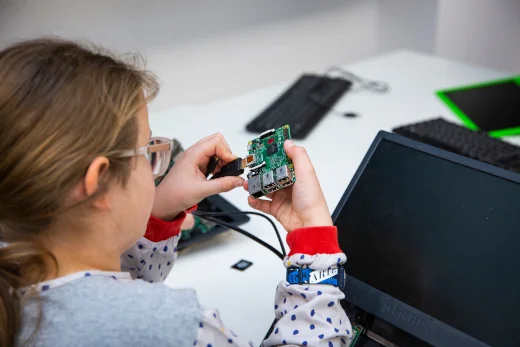
Some technologies like VR exploration learning, interactive art and music technology is amazing and can have [manifest benefits]. One of the best uses of technology in schools is learning technology itself, programming, maths and building interactive robots using technology like [Raspberry Pi].
Gains;
- Immersive learning
- Personalised, age and skill appropriate
- Motor skills, hand-eye, navigation
- Typing and language skills
- Can continue at home (especially if FOSS)
Harms;
- Overuse of screen time instead of face-to-face teaching
- Allowing smartphones in the school
- Selling child's data to advertisers and data brokers
- Clash with parental values
- Exposure of children to advertising
- Exposure to inappropriate content
- Psychological harms of surveillance
- Surveillance of child outside school
- Psychological attachment harms from "AI"
- Improper security of surveillance or biometrics
Proactive parents should investigate their child's school's use of technology.
Make sure school's [basic cybersecurity] is up to standard. Specifically;
- [Data protection] compliance
- Privacy compliance
- Proper anonymisation of data
- [Proper secure storage of data]
- [Proper use of cloud]
Make sure your school has a competent IT department that's able to deploy Free Open Source Software and protect your children from Microsoft, Google and other intrusive US Big Tech.
Ask about the timing and usage patterns;
- How much screen time versus face time are they getting?
- How long are the sessions?
- Is your child being individually tracked?
- Is their activity tied to their real-world identity or are the school properly using pseudonyms or anonymous "open use"?
- Are cameras or face recognition software ever used in class?
- Are the activities cooperative or competitive?
- What is your child's mood/response to tech activities?
Ask for a full inventory of all software and devices used in teaching your child; your school should have one. Check for safeguarding devices and data handling procedure.
Request anonymisation if you're worried about schools using childs real name. Best practice is that nobody outside the school can tie your child to their activities, even after a data breach.
Raise questions on anything you don't understand and follow up until satisfied.
Challenge the use of software that harvests data or manipulates your child psychologically.
Ask teachers not to expose your children to educational apps, websites or devices that you do not approve of or think are unsafe. Ask to see these applications or have a parental login account if cloud based. If necessary reserach and suggest your own alternatives and as a last resort withdraw your child from those classes.
Help schools with phone ban
Whether to issue your kid a phone is a separate matter to whether they're allowed one in school. Unfortunately the effects of phones in schools is devastating, and we're with all teachers who think they should be totally banned.
The problem obviously arises at the interface - at the school gate. As parents we can worry a lot about our kids in transit. That depends on the neigborhood, the journey and the child's confidence. Being in a group who walk or bus together is a very different situation from the kid who has to walk alone down main street.
Interestingly, when childen are very young we don't even think about giving them phones. We pick them up at the gate at the same time every day. If there's a problem the school calls.
Many of the tensions come as they get older and expect more leeway. In this regard a phone is an instrument of freedom and autonomy. Uses include:
- to let someone know you're delayed
- to call for pickup
- to change plans - "Mom, we decided to stay and play tennis"
Schools could really help by offering unlimited free voice and text communicaton from facilities in the entrance hall.
Schools need to manage secure phone storage, with lockers or safe boxes at the main doors.
Even though the House of Lords has green-lighted a full ban of smartphones and social media for under 16s, schools or youth groups will need time to adapt and work out procedures.
Ask your child about what they feel. Identify:
- whether they feel safe without a phone
- would they rather just leave it at home
- peer pressure
- attitudes in the school
- other pressures to use specific tech (eg. they need it for a school trip)
Understand their attachment needs
If they are safe, psychologically confident and securely attached then do encourage and support them if they want to be phone-free.
Up to a certain age, they will want to have the phone and initiate most check-in calls while they explore boundaries.
Past a certain age, they may want to assert independence by not carrying a phone when they choose. Allow healthy separation, and be careful not to let your own anxieties drive those choices.
Finding support
The aim is not to become "that one parent" who kicks up a fuss but rather find and work with other parents, teachers and local groups who are on-side to move the dial.
The goal is to change culture in the same way that smoking was made unacceptable. It takes time. There are powerful interests to fight.
You will encounter lots of misinformation and minimising of evidence. Remember it's the tech industry that controls the channels by which you obtain information.
Share stories of experiences - effects of "AI", smartphones and social-media on you and your kids, but especially share positive stories of newfound happiness and learning improvements after giving up smartphone and social media.
Governments, evidence and action
All governments are conflicted (within) and even the best ones generally lag behind following changing societal attitudes. Good governments are reluctant to commit to "one size fits all solutions" but instead foster [interoperability] and choice.
Illiberal, undemocratic governments seem to want people to have smartphones and to use them excessively. Mobile technology is a powerful social control mechanism. Authoritarian elements rejoice that smartphones provide easy tracking of people and almost endless data. Corrupt governments like to sell citizen data to Big Tech to make money, and buy data back from Big Tech to supplement intelligence gathering that would be illegal if carried out in the public sphere.
It is important to vote for government that has smart people, a sane attitude and reasonable policy to digital harms and choice. That's hard because even the best governments have lot of catcing up to do understanding the long term social and economic implications of technology. The Online Safety Act which we supported for a long time took [six years], four governemnts and fourteen significant stages to get through to assent - and was still a dogs dinner of contradictions, impossible asks and frightening assults on privacy and free speech - just to achieve the rather simple aim of preventing children seeing gore and porn which could have been 95 percent achieved with technical measures to block those sites at source.
But nobody wanted to upset Mr Zuckerberg and his friends.
The current British government (lab), which it is fair to say is still too close to Big Tech, is quiescent to the point of rather disingenuously claiming ["there's no evidence"] linking childhood mental health problems to smartphones. Today we consider this dishonest and suspicious. We expect them to update that position very soon.
Ask your M.P. where they stand on;
- their personal understanding of individual and societal harms
from;
- smartphones
- social media
- advertising industry
- violation of childrens' privacy rights
- surveillance
- "AI"
- what is interoperability and why does it matter?
- what is software freedom? How do they support it?
- proximity of their government to the tech industry
- deals and policy-making with tech companies
Conclusion
Positive digital parenting is mostly about sharing your child's digital life, helping them make good choices and slowly letting go of oversight. Build trust and figure it out together.
Parents and children face the same threats. Don't be pressured or bamboozled. Don't be shamed or belittled and make your own choices to use more, less or no tech, as you feel appropriate.
Reach out to others and create groups, conversations and mutual-aid. Work with, not against, teachers and school heads to;
- agree on values and goals
- tailor flexible process for different ages and needs
- share intel on threats and bad actors
Don't let technology take the driving seat. It's just a tool. Put family and community before consumerism and conformity. School should be about your child's socialisation, health, safety and happiness - not about "being competitive" or "what industry wants".
Real friends, outdoor time, and working towards independence and self-confidence are much more important life skills than using "AI", smartphone apps or corporate software.
All kids are different. Some will be more vulnerable to digital harms, others will naturally master tech in their own way. Work with your kid to make good choices.
Where to get help
Suggest more links to accessible science, active groups for discussion and action, links to books (author/publisher website if possible [no Amazon links])
TODO Online
- Smartphone-free Childhood
- A charitable collective of sane people trying to restore healthy childhood through better use of technology
- [Smartphone-free]
- Mums Net
- Where things really get discussed and decided.
- [Mums-Net]
- Carmen Lisandrette's Mission Libre
TODO Books
- [iRules] Popular, accessible, practical, up to date.
- [Parents and Digital Technology] Balanced and many good research citations
- [Exploring Key Issues in Early Childhood and Technology] Academic short essays focused on formative development with many practical insights and interventions.
- [Digital Vegan] Old now, but anticipates many current problems in a broad context and accessible style.
Media
We discuss digital parenting and teaching in these Cybershow episodes (some may contain mature language so please review before using for discussion in class or with young people):
https://cybershow.uk/media/episodes/digitalparent.mp3
Footnotes:
Brookings Institute concludes that "AI" too harmful for schools https://www.brookings.edu/articles/a-new-direction-for-students-in-an-ai-world-prosper-prepare-protect/
The most well known text examining multiple large meta-studies on technology induced anxiety is Jonathan Haidt's Anxious Generation https://www.penguin.co.uk/books/456971/the-anxious-generation-by-haidt-jonathan/9780241647$
Recent report that a "growing number of college professors are sounding the alarm over a quiet but accelerating crisis on American campuses": that Gen Z students are arriving at college [unable to read].
Aaron Balick offers a very positive perspective on some digital habits that might help re-frame obsessive behaviours. Understanding "hope scrolling" might help us re-examine what we are really getting out of digital interaction and how to change it. https://newsletter.aaronbalick.com/p/why-doomscrolling-is-secretly-a-search